

You handle bulk inventory by the bag, not by guesswork. Choosing container sizes here means matching your bag counts to real-world cubic space so you load efficiently and avoid wasted trips.
This short buyer’s guide explains how to translate bag counts into usable cubic feet, verify internal versus external dimensions, and spot common fit and loading mistakes. You’ll learn to check door openings, weight limits, and whether a high cube option makes sense for tall pallets.
The choice affects delivery access, daily handling, and total lifecycle cost. Think beyond advertised volume: aisles, headspace, pallets, and dunnage cut into usable capacity, so plan for real loading conditions.
We use common U.S. market standards — 10′, 20′, 40′, 40HC, 45HC, and 53′ domestic high cube — and the practical questions to ask before you order the right size for your needs.
Why container dimensions matter when you’re matching standard bag volumes
Accurate dimensions decide whether your stock fills space — or leaves costly voids. Getting interior measurements right means you plan by usable cubic feet, not by advertised volume. That reduces wasted trips and lowers per-unit shipping and storage costs.
Space planning starts with width and height. Narrow aisles or low headroom can force odd stacks that lose usable space and increase damage. Door openings matter: a good fit speeds loading and prevents crushed or stuck goods.
Why load efficiency and safety improve with the right fit
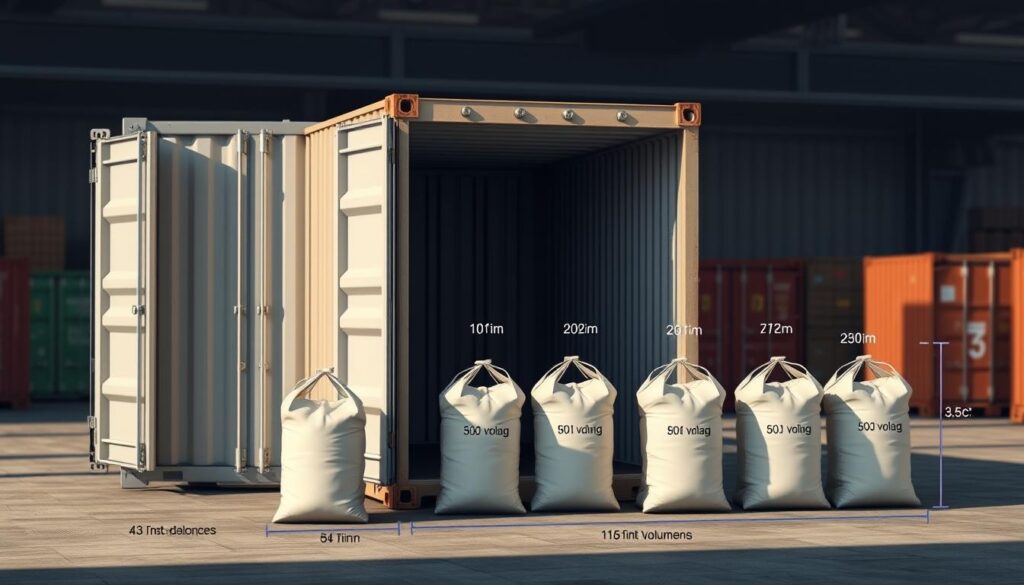
Loading efficiency depends on internal width, height, and even floor layout. Proper weight distribution reduces shifting and bag rupture during shipping.
Cost and transport constraints in the U.S.
- When you pick a size, think total costs: equipment, delivery, and on-site handling.
- Some ports, yards, and rail routes limit oversize equipment. That affects logistics and use.
- Balancing volume, access, and handling is the real measure of the right fit.
How to convert your bag volume into container space you can actually use
Turn your bag count into a usable cubic measure before you book any transport. Start by multiplying the bag volume per unit by the number of units you have to get total cubic feet. Always check the product bag’s cubic value on the spec sheet so your math uses real numbers.
Calculating total cubic feet from bags, pallets, and stacking height
Measure a single bag’s cubic volume, then multiply by your items or units. If you palletize, use the pallet footprint and the stacking height to convert layers into cubic feet. For example: pallet area (feet) × stack height (feet) gives the pallet cubic figure.
Planning for headspace, aisles, and dunnage
Reserve headspace above stacks for airflow and settling; subtract that from your usable volume. Account for aisles if you need to enter the space or use equipment like forklifts or pallet jacks. Finally, add space for dunnage—load bars, airbags, and blocking—before you pick a container size.
- Quick checklist: bag cubic × units, adjust for pallets and height, subtract headspace, aisles, and dunnage, then compare to usable cubic feet.
- Make your final choice on usable cube, not the advertised number.
Internal vs external container dimensions and why the difference changes your fit
Interior room and exterior footprint often tell two different stories about what will actually fit. Internal dimensions are what determine how many bags, pallets, or racks you can stack. External measurements are what affect placement on your site or a chassis.
Internal dimensions vs outside footprint for site placement
The walls and doors eat into usable space. For example, a 20′ unit typically gives ~19’4″ of internal length and a 40′ about ~39’5″. That difference changes how many rows or pallets you can load.
Outside footprint matters for clearances, setbacks, and delivery access. Confirm the external length and width when planning staging or site placement.
Door opening dimensions that can block bulky goods at loading time
Doors are a common failure point. Standard door openings run about 7’8″ wide × 7’5″ high. If your pallet or bag pallet is wider or taller, you may not get goods through even if they fit inside.
ISO measurements vs real-world variation by manufacturer and type
ISO specs set a baseline, but real-world shipping container dimensions vary by maker and age. Always check the unit’s datasheet or measure the interior length, width, and height before finalizing a load plan.
- Pro tip: Verify internal width and height on the exact unit to avoid surprises.
- Impact on bag volumes: Small reductions in width or height can cut bags per row and affect stack stability.
Standard shipping container sizes and typical bag-volume use cases
Match your bag counts to real-world feet and you’ll avoid wasted trips and surprise fees. Below are the common U.S. standard shipping container footprints and when each best fits bagged goods.
Ten-foot standard unit for tight sites
The 10′ standard shipping container (10’×8’×8’6″) gives roughly ~560 cubic feet. Use it for small inventory, short-term storage, and jobs with tight access.
Twenty-foot workhorse for dense, heavy goods
The 20′ standard shipping container (20’×8’×8’6″) offers about ~1,170 cubic feet. It handles dense, heavy loads well and is ideal when weight, not just volume, limits your plan.
Forty-foot for high-volume storage and logistics
A 40′ standard shipping container (40’×8’×8’6″) yields ~2,390 cubic feet. It gives the best cost per cubic foot for bulk storage but needs more site space and careful access planning.
Quick reference comparison
- 10′ — 10’×8’×8’6″, ~560 cu ft — tight sites, small runs.
- 20′ — 20’×8’×8’6″, ~1,170 cu ft — dense goods, mid loads.
- 40′ — 40’×8’×8’6″, ~2,390 cu ft — high volume, best per-cubic economics.
Practical tip: translate length and width into how many bag rows fit, leave aisles for access, and remember that double the length does not always double usable cube if you need frequent entry.
High cube containers for extra height when your bags need more vertical space
If vertical room is tight, an extra foot of headspace can turn a partial load into a full one. High cube units add roughly 1′ of external height (9’6″ vs 8’6″), which increases usable cube without changing your footprint.
What one extra foot delivers
The extra height improves stacking and shelving. You get safer clearance, taller pallet stacks, and better rack layouts. That matters when you can’t expand width or length but need more usable cube.
Typical high cube volumes to compare
- 40′ high cube: ~2,694 cu ft — common upgrade for tall stacks and shelving.
- 45′ high cube: ~3,040 cu ft — extra length without changing the typical 8′ width; good when you’re just over a 40′ fit.
- 53′ domestic high cube: ~3,850–3,860 cu ft — max domestic cube in the U.S.; usually 8’6″ wide and not ISO sea-rated.
When high cube makes sense beyond storage
For office or workshop builds, the taller interior helps with insulation, HVAC runs, and full-height doors. It also gives more room for equipment and living use in modified homes or mobile offices.
Buyer guidance: pick a standard high cube when your loading method, site access, and vertical stacking needs justify the extra headroom. If you mainly need floor area, length or width upgrades may be better.
Choosing container sizes for your operation: a buyer’s checklist
Start by mapping what you store to realistic load plans, not marketing numbers. A quick checklist keeps your choice grounded in real workflow, so you order the right size that works day-to-day.
What you store and how it affects the fit
Classify your goods: heavy, dense bags favor shorter units for weight control. Bulky, light items may justify a larger footprint. Note fragile or stack-sensitive items.
Height for stacking, racking, or equipment
Estimate stack height and allowance for racks or forklifts. If you routinely need extra headroom, a high cube or taller option is the practical choice.
Portability and movement frequency
If you move units between sites, smaller options simplify trucking, permits, and placement. Fewer moves reduce scheduling friction and handling risk.
On-site space, delivery, and daily access
Verify delivery path, turning radius, overhead lines, and gate clearances. Plan aisles, first-in/last-in access, and pallet-jack-friendly layouts before you finalize the right size.
- Do the math: items × per-unit volume, adjust for pallets and headspace.
- Check weight: confirm payload limits and local delivery rules.
- Walk the site: confirm access, turning, and door clearance.
- Pick the right size: choose the unit you can safely deliver, load efficiently, and use daily without constant rearranging.
Weight, payload, and load ratings that can cap your usable volume
Weight limits often stop you long before cubic space runs out. For dense goods or heavy machinery, you can fill a shipping container physically but exceed legal weight limits. Plan by both mass and cube to avoid fines and unsafe moves.
Tare, payload, and max gross — what you must read
Tare weight is the empty unit weight. Payload is the maximum cargo you may load. Max gross equals tare plus payload — the legal limit for transport. Typical tares: ~4,800 lb for a 20′ and ~8,400 lb for a 40′. ISO max gross often sits near 67,200 lb; always verify the exact plate.
Why a 20-foot option can beat longer units for heavy loads
Shorter units let you stay under axle and handling limits more easily. If your bags or machinery are dense, a 20-foot unit often saves on permits and reduces overloading risk.
Using the CSC plate to avoid overloading and fines
Read the CSC plate for official tare, payload, and max gross numbers. Match those values against your goods’ weight and your planned bag volume. Distribute weight evenly to prevent shifting and damage during shipping.
- Quick checks: verify plate numbers, compare cargo weight to payload, and stop loading once you hit the legal limit.
- Safety: spread heavy bags, secure machinery, and plan unloading to avoid hazards.
Budget and logistics considerations that affect the “right size” decision
Total landed cost is more than the purchase price. Add delivery fees, site prep, permits, and expected maintenance to see real value. This view helps you avoid surprises when you deploy units for storage or moves.
Total cost drivers: container price, delivery fees, site prep, and long-term value
Start by listing purchase, drop-off or trucking, and any crane or lift charges. Include site prep: pad, fences, and clearance work. Then weigh long-term value—will the unit be a one-time rental or an asset you reuse?
TEU and FEU basics for planning capacity across carriers and routes
TEU = 1 for a 20′ unit; FEU = 2 TEUs for a 40′ unit. Use these terms when you talk to carriers to plan capacity, book space, and compare per-TEU shipping rates.
- Compare cost per cubic foot, but respect access, workflow, and weight limits.
- Upsizing can raise delivery complexity in the U.S. and add indirect fees.
- Domestic 53′ units work well for truck/rail planning but differ from ISO shipping containers for ocean moves.
Practical tip: balance budget and operational efficiency. Pick the size that minimizes your true costs over time, not just the lowest upfront price.
Conclusion
A reliable choice starts when you plan by actual usable space, door clearances, and weight limits. First, convert your standard bag volumes into usable cubic feet, then check those figures against the exact container dimensions and door openings you’ll use for loading.
Remember that internal space and access needs cut into usable volume. Factor headspace, aisles, and dunnage so your plan reflects daily handling, not idealized math.
Standard containers often win for simple storage and routine loads. Opt for high cube containers when vertical stacking, shelving, or modified use adds value. A smaller container can beat a larger one for dense goods because weight ratings may cap your usable cargo.
Next step: shortlist 2–3 sizes, confirm internal measures and the CSC plate, then request delivery-inclusive quotes. With volume, dimensions, access, weight, and cost checked, your choice becomes measurable—not guesswork in shipping.